
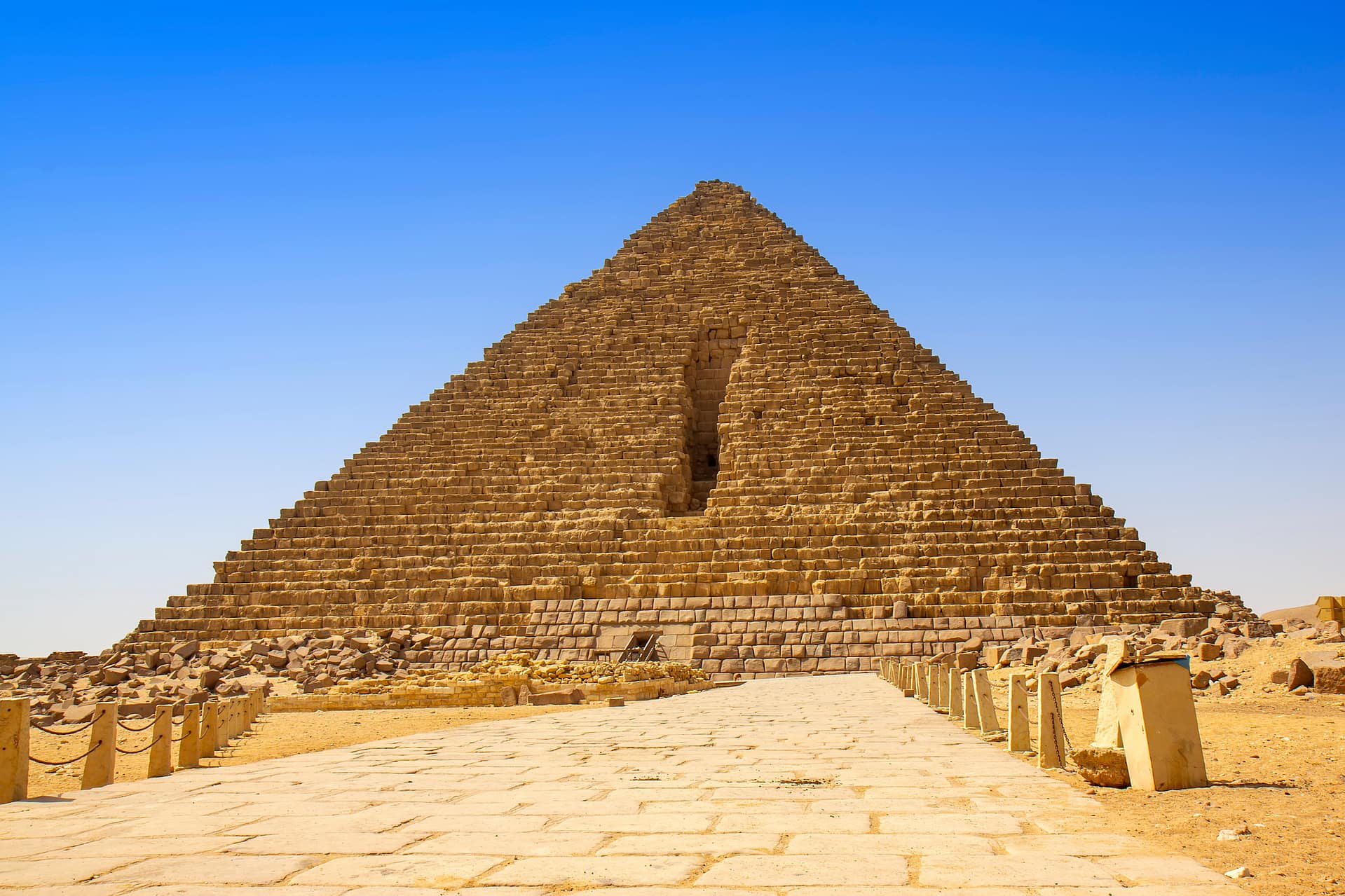
The Giza Pyramids Complex stands as a profound testament to human ingenuity and determination. It features the Great Pyramid, the last surviving wonder of the ancient world, alongside two other remarkable pyramids. Serving as a royal necropolis, it reflects ancient Egypt’s architectural mastery, political strength, and spiritual beliefs. The site also includes the Sphinx, workers’ village, smaller pyramids, cemeteries, and causeways, collectively symbolizing the grandeur of this civilization.
The Pyramids of Giza: Enduring Monuments of Ancient Egyptian Civilization
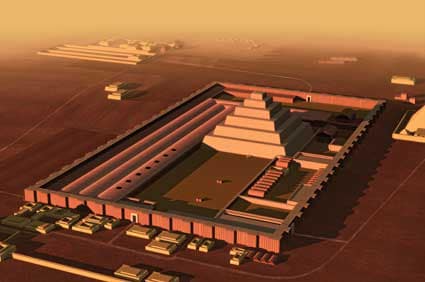
The complex stands among the last surviving prehistoric monuments on Earth, constructed during Egypt’s Old Kingdom (2686–2181 BC), specifically within the Fourth Dynasty (2613–2493 BC). For over four millennia, it has continued to captivate all who encounter it.
The site comprises the three monumental pyramids of Khufu, Khafre, and Menkaure, each built as an enduring testament to royal legacy and the aspiration for immortality. These pyramids served as final resting places for the pharaohs, designed to facilitate their journey to the afterlife and eternal union with the divine.
Adjacent to the pyramids lies the Valley Temple, where royal mummification rituals were performed. Here, kings and queens were carefully prepared for their passage into the afterlife, ensuring their transition to the next world in accordance with ancient Egyptian beliefs.
Strategic Location Overview
Pyramids Complex – Strategic Location Overview
The complex is strategically situated in the Western Desert, approximately 9 kilometers (5 miles) west of the Nile River and 13 kilometers (8 miles) southwest of Cairo’s city center. It lies in close proximity to the historic city of Memphis, offering both accessibility and significant cultural context.
The Purpose of The Giza Pyramids Complex
The Giza Pyramid Complex: Purpose, Design, and Historical Context
The Purpose of The Giza Pyramids Complex The main purpose of constructing the Giza pyramids complex is to preserve and protect the mummies of the ancient Pharaohs so their spirit known as “Ka” can remain with the pharaoh’s corpse so later on it could return to the body once again and fully transform and ascend to the afterlife. The ancient Egyptians including the kings believed that death was part of a journey to the other world known as the fields of reeds. The pyramid acted as a safeguard for the body and spirit of the Pharaoh in order to be the new king of the dead. The Pyramids of Giza were stored with all the items needed in the afterlife.
The Giza Pyramids Complex: Layout and Historical Context
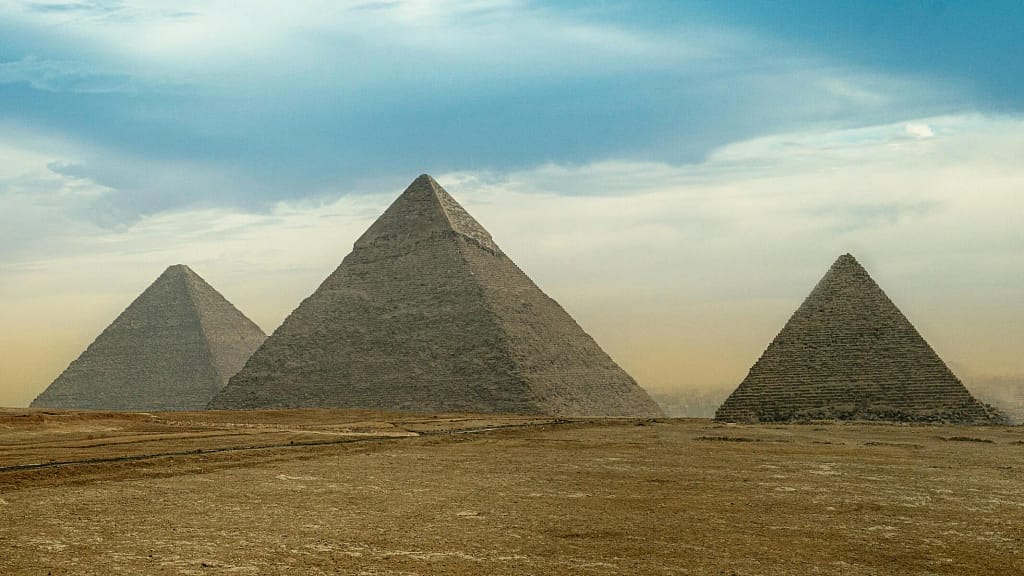
The Giza Necropolis spans approximately 16,203.36 hectares (62.56 square miles) and encompasses the three principal pyramids of Khufu, Khafre, and Menkaure. Each of these monumental structures is accompanied by subsidiary complexes, including smaller pyramids traditionally attributed to royal consorts and family members.
Positioned to the east of the complex stands the Great Sphinx, widely regarded as a symbolic guardian of the necropolis. Scholarly interpretations have suggested that the spatial arrangement of the pyramids may reflect celestial alignments, most notably the Orion Correlation Theory, which posits a relationship between the pyramids’ layout and the stars of Orion’s Belt.
In addition to the primary pyramids, the site includes various auxiliary structures such as queen’s pyramids, valley temples, mortuary temples, and causeways, all of which played integral roles in ancient Egyptian funerary practices. Evidence of historical looting is prevalent throughout the complex, as many tombs were subjected to robbery, resulting in damaged interiors and the loss of burial goods, including treasures and mummified remains.
Encircling the necropolis is a substantial stone enclosure, within which archaeologists have identified the remains of a workers’ settlement. This “workers’ village,” dating to the mid–Fourth Dynasty (circa 2520–2472 BC), provides significant insight into the organization and labor force responsible for constructing these enduring monuments.
How the Pyramids Were Built
The question of how the pyramids were built remains one of the most significant and complex topics in construction history. Prevailing theories suggest that the pyramids were constructed by quarrying massive limestone blocks—each averaging approximately 2.5 tons—and transporting them to the Giza Plateau, where they were methodically positioned.
Highly skilled architects and engineers employed advanced surveying techniques to precisely align the foundations. The construction process is widely believed to have progressed in horizontal tiers, with each layer carefully placed to ensure structural integrity, symmetry, and balance. Remarkably, the pyramids at Giza are aligned with extraordinary precision to the cardinal directions—north-south and east-west—within a fraction of a degree. This level of accuracy has led to associations with astronomical theories, including correlations with the Orion constellation.
The durability and precision of these structures are evident in their continued existence after more than 4,500 years. Today, the Giza pyramid complex stands not only as a testament to ancient engineering excellence but also as a global attraction, drawing millions of visitors and scholars annually.
Great Pyramid of King Khufu: Engineering, Scale, and Architectural Significance
The Great Pyramid of King Khufu, the last surviving wonder of the ancient world, was constructed during Egypt’s Old Kingdom between approximately 2580 BC and 2560 BC, with an estimated build period of 20 years. Also known by its Greek name, Cheops, the structure achieved an original height of 147 meters (481 feet), maintaining its status as the tallest man-made structure for over 3,800 years until the completion of Lincoln Cathedral in 1311.
The pyramid was constructed using approximately 2.3 million limestone blocks, each weighing an average of 2.5 tons, resulting in a total mass of roughly 5.75 million tons. The workforce is widely estimated at around 100,000 laborers, organized in rotating shifts. The structure’s sides are inclined at an angle of 51°52′ and are precisely aligned with the four cardinal directions, reflecting remarkable engineering accuracy for its time.
The project was overseen by Hemiunu, the vizier of King Khufu, who is credited with delivering one of the most extraordinary architectural achievements of the ancient world, utilizing the full economic and logistical capacity of Egypt’s Old Kingdom.
Internally, the pyramid features a sophisticated layout comprising three primary components: the King’s Chamber, constructed entirely of granite; the Queen’s Chamber; and the Grand Gallery, an imposing ascending corridor. Additionally, the Solar Boat of King Khufu—originally discovered within the pyramid complex—has since been carefully relocated to the Grand Egyptian Museum, further emphasizing the cultural and historical significance of the site.
The Step Pyramid of Djoser: Egypt’s First Monumental Stone Structure
The Step Pyramid at Saqqara, commissioned by King Djoser—also known as Netjerykhet—dates to the early Third Dynasty of the Old Kingdom (circa 2670–2650 BC). Often regarded as the first, or possibly the second, ruler of this dynasty, Djoser governed for approximately 19 years, a reign long enough to witness the completion of his groundbreaking funerary complex.
This pyramid represents a pivotal innovation in ancient Egyptian architecture. Unlike earlier structures constructed from mud brick, Djoser’s pyramid was built using cut limestone, marking the earliest known use of stone on such a monumental scale. Its distinctive stepped design set it apart from prior burial forms and established a prototype that influenced subsequent pyramid construction for generations. The Step Pyramid thus stands as the first large-scale stone monument in human history, underscoring Djoser’s ambition to create a lasting and unprecedented architectural legacy.
Saqqara Step Pyramid Architecture and Design Features
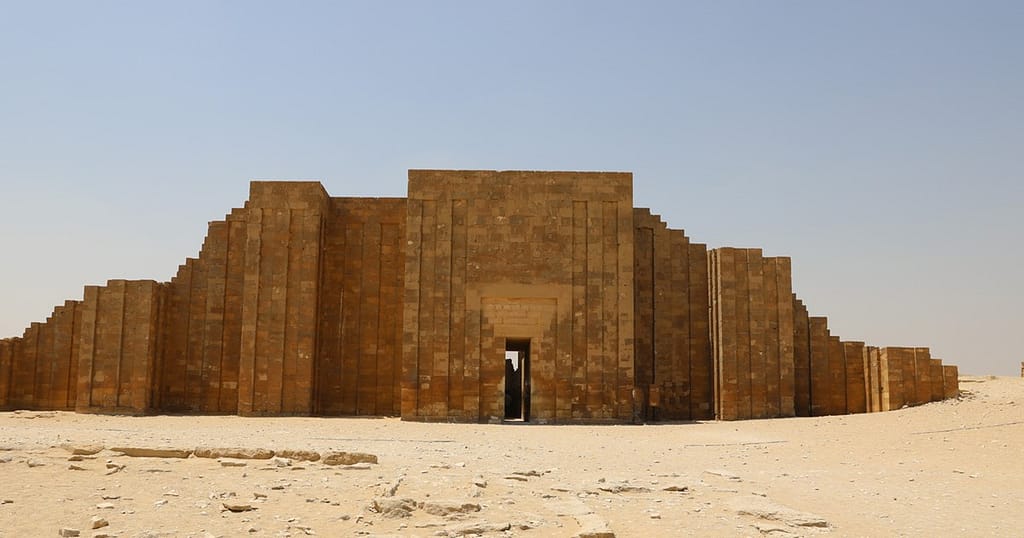
The Saqqara Step Pyramid, constructed for Pharaoh Djoser, is a pioneering architectural achievement distinguished by its precise alignment with the four cardinal directions. As the earliest monumental stone structure of its kind, the pyramid complex represents a significant evolution in ancient Egyptian funerary design, intended to facilitate the king’s journey to the afterlife and ensure eternal rebirth.
Encircling the complex is a 10.5-meter-high limestone enclosure wall featuring fourteen symbolic doorways and a single functional entrance. While the main प्रवेश served the living, the false doors were designed as spiritual gateways, enabling the pharaoh’s soul to transition into the afterlife.
Beneath the pyramid lies an intricate subterranean system. The king’s burial chamber, located at the core, measures approximately 13 feet in length and is constructed of granite. It once contained thousands of inscribed stone vessels bearing the names of earlier rulers, though it was later looted.
Extending below is a vast labyrinthine network reaching a depth of approximately 28 meters and spanning nearly 6 kilometers. This complex includes a central shaft of about 7 square meters, interconnected galleries, corridors, and chambers. Within these spaces, archaeologists have discovered over 30,000 stone jars made from materials such as alabaster, slate, and marble, many inscribed with the names of kings from Egypt’s First and Second Dynasties.
Saqqara Step Pyramid: Construction and Architectural Significance
The Saqqara Step Pyramid is widely recognized as the earliest large-scale cut-stone structure in history, marking a pivotal evolution in ancient Egyptian funerary architecture. This monumental complex revolutionized both stone construction techniques and royal burial practices.
The pyramid is composed of six stacked mastabas built from limestone, forming a stepped structure on a base measuring approximately 109 meters by 125 meters (358 ft x 410 ft). It rises to a height of about 62 meters (203 ft) and has an estimated volume of 330,400 cubic meters (11,667,966 cubic feet).
Beneath the structure lies an extensive underground network of chambers and galleries extending nearly 6 kilometers. These subterranean passages are connected to a ცენტრাল shaft approximately 28 meters deep and 7 meters wide, reflecting early design principles later seen in the pyramids of Giza, including that of Khufu.
Although commonly associated with later archaeological work, the modern understanding of the site is largely attributed to the French architect and Egyptologist Jean-Philippe Lauer, who began extensive excavations and restoration efforts in the 20th century. Following a 14-year restoration project, the Saqqara Step Pyramid complex was officially reopened to the public in March 2020.
Step Pyramid Complex Overview
The Step Pyramid Complex is an extraordinary architectural and symbolic ensemble that includes the Step Pyramid itself, the House of the South, the House of the North, the Heb Sed Court, the Serdab, Temple T, the South Tomb, and the Northern Mortuary Temple, all enclosed within a massive surrounding wall. This unified complex was designed to facilitate the pharaoh’s journey into the afterlife and ensure his eternal rebirth.
The House of the North and the House of the South symbolically represent Lower and Upper Egypt, reinforcing the king’s dominion over a unified land. Within the central courtyard, these structures are accompanied by thirteen small chapels, further emphasizing ritual and ceremonial functions.
A key feature of the Step Pyramid Complex is the Serdab (meaning “cellar”), a limestone chamber located near the pyramid’s northern entrance. It houses a life-sized statue of King Djoser—the oldest known surviving life-sized statue from ancient Egypt—which played a critical role in sustaining the king’s soul (ka) in the afterlife.
The Heb Sed Court was designed for royal jubilee ceremonies, traditionally celebrated after 30 years of a king’s reign to renew his शक्ति and legitimacy. Nearby, the South Tomb contains three intricately carved panels depicting Djoser performing the Heb Sed ritual, reinforcing the theme of renewal and kingship.
Architecturally, the complex contrasts a relatively plain exterior façade with a richly adorned interior. Inside, structures are embellished with Djed pillars, symbolizing stability. The colonnade features 40 engaged columns—attached to the walls rather than freestanding—demonstrating an early and significant architectural technique used to support roofing systems. Adjacent chambers within the colonnade are filled with statues portraying Djoser as ruler of both Upper and Lower Egypt.
The Northern Mortuary Temple serves as the entrance to the subterranean passages leading to Djoser’s burial chamber. This chamber is a granite vault constructed from four courses of finely dressed stone, originally sealed by a massive 3.5-ton block. Although it was later looted, the chamber remains architecturally significant. Its ceiling is adorned with five-pointed stars, believed to symbolize the eternal northern circumpolar stars—an enduring emblem of the pharaoh’s immortality.
The walls of the subterranean chambers are decorated with reliefs depicting the Heb Sed festival, symbolically ensuring the king’s continued reign in the afterlife. Among the intricate carvings is a representation of a half-opened door, interpreted as a symbolic gateway between the earthly realm and the afterlife.
Leave a Reply